By the time the cherry blossoms have fallen on Honshu, Lake Toya is only just entering its flower season. The lakeside blossoms are usually at their best in early May, around Japan’s Golden Week holidays. Lake Toya is about 40 km around, roughly an hour by car—and the fact that this single loop doubles as a cherry-blossom course is one of the greatest luxuries of this place.
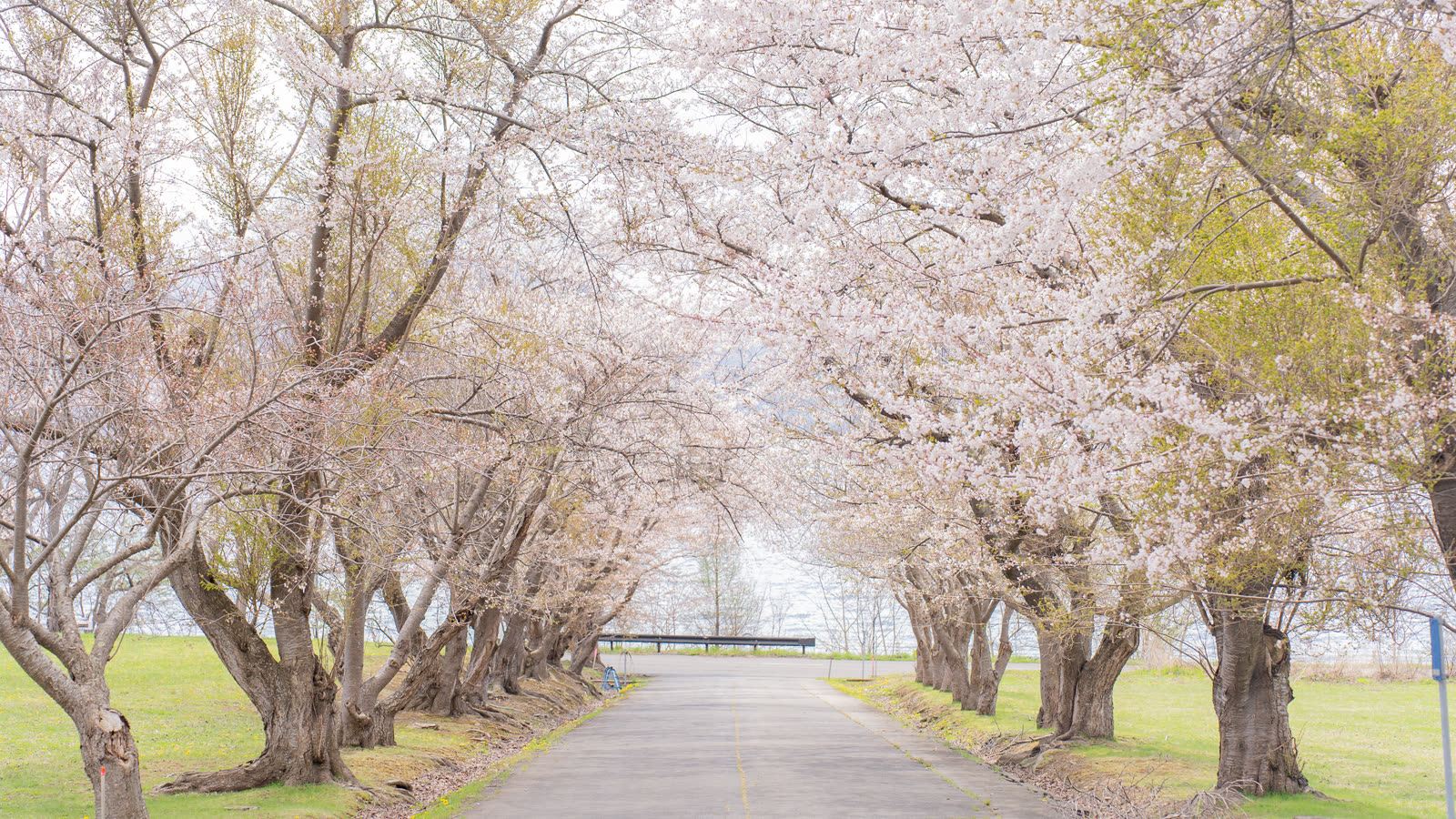
Kamonoya, which runs 11 whole-house rentals around Lake Toya, offers this guide to the cherry-blossom drive for those who will be behind the wheel. Lake Toya in spring as a whole is covered in our spring at Lake Toya guide, and the full picture of the cherry-blossom spots is gathered in cherry blossoms and spring highlights of Lake Toya, so here we focus on one thing: how to make the loop.
The 40 km loop around Lake Toya is itself a cherry-blossom course
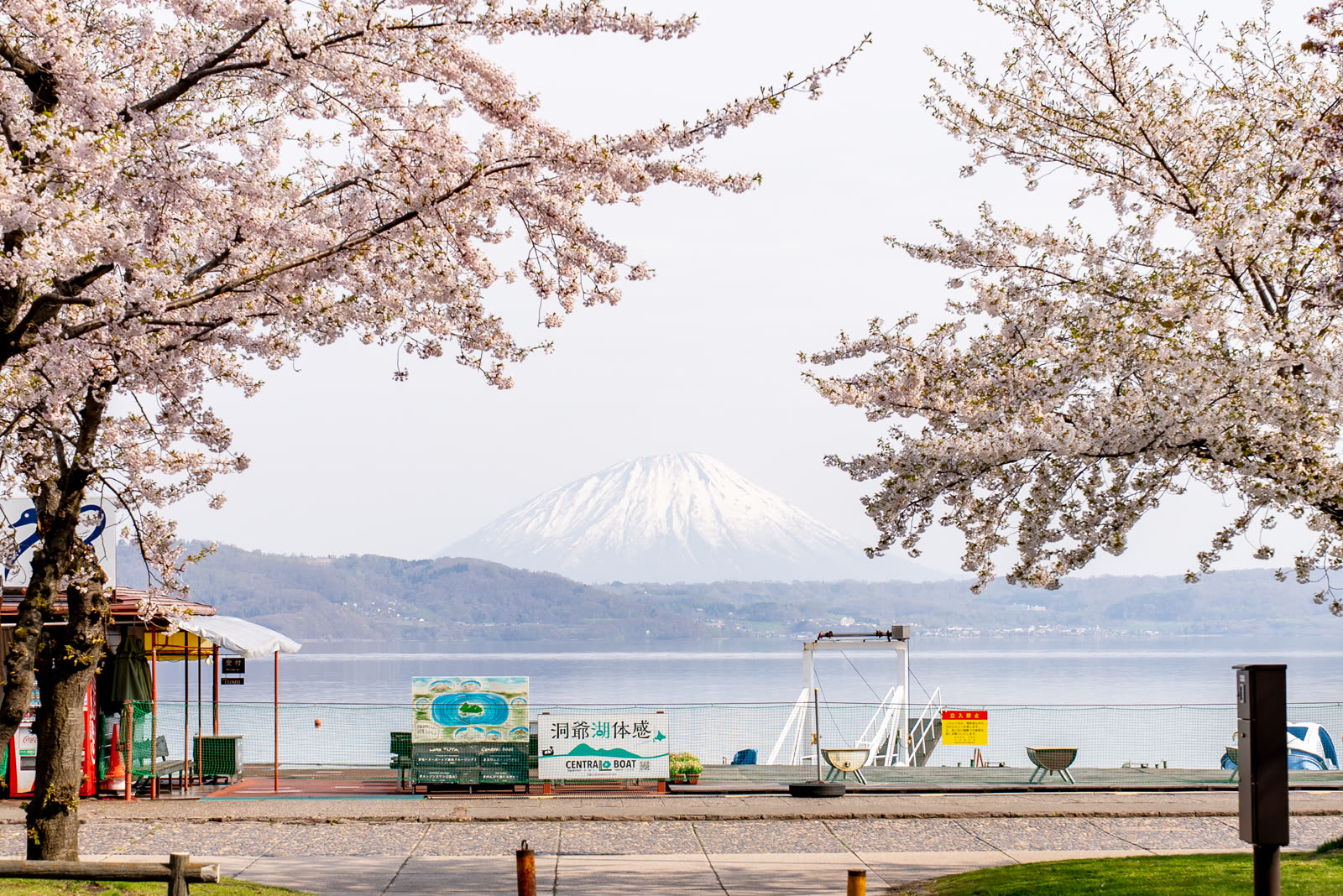
There are cherry-tree avenues along the shore of Lake Toya, and stretches of blossoms continue along the town roads as well. A loop of about 40 km—roughly an hour by car—is just the right scale for cherry-blossom season. Nonstop it takes an hour, but you will want to stop for photos and short walks, so allowing about half a day gives you room to relax.
The blossoms are usually at their best in early May, though the timing shifts from year to year with the temperature. Even along the same shore, a difference of a few days can appear depending on elevation and sun exposure, and there are days when “the south side is already starting to fall while the north side is at full bloom.” That is exactly why the loop is worth making. You can also see late bloomers such as double-flowered cherries, so even after the Yoshino cherries are done, it may be too soon to give up. For the latest bloom conditions, please check the official announcements from the local municipalities and tourism associations.
Capturing lake and mountains in a single frame, through the blossoms
What makes the cherry blossoms of Lake Toya special is that there are places where you don’t just look up at the flowers—you view the lake and mountains together, framed through the cherry branches. Beyond the pale pink flowers lie the blue of Lake Toya and Nakajima floating upon it. Lift your gaze a little higher and you can see Mount Yotei and Mount Usu, still capped with snow. Even in early May the mountains hold plenty of lingering snow, and the pink of the blossoms, the blue of the lake, and the white of the snow all fit into one frame for just a few days at this time of year.
Along the drive there are scenes that make you want to stop the car and look back—like a red bridge wrapped in cherry blossoms. You may also come upon a lone cherry tree standing in the middle of a field, and because it isn’t marked on any tourist map, there is the joy of having “found” it. Many of these are local residents’ roads, so when you stop, always park in a safe place, and please do not enter farmland or private property.
Detours worth building into the drive
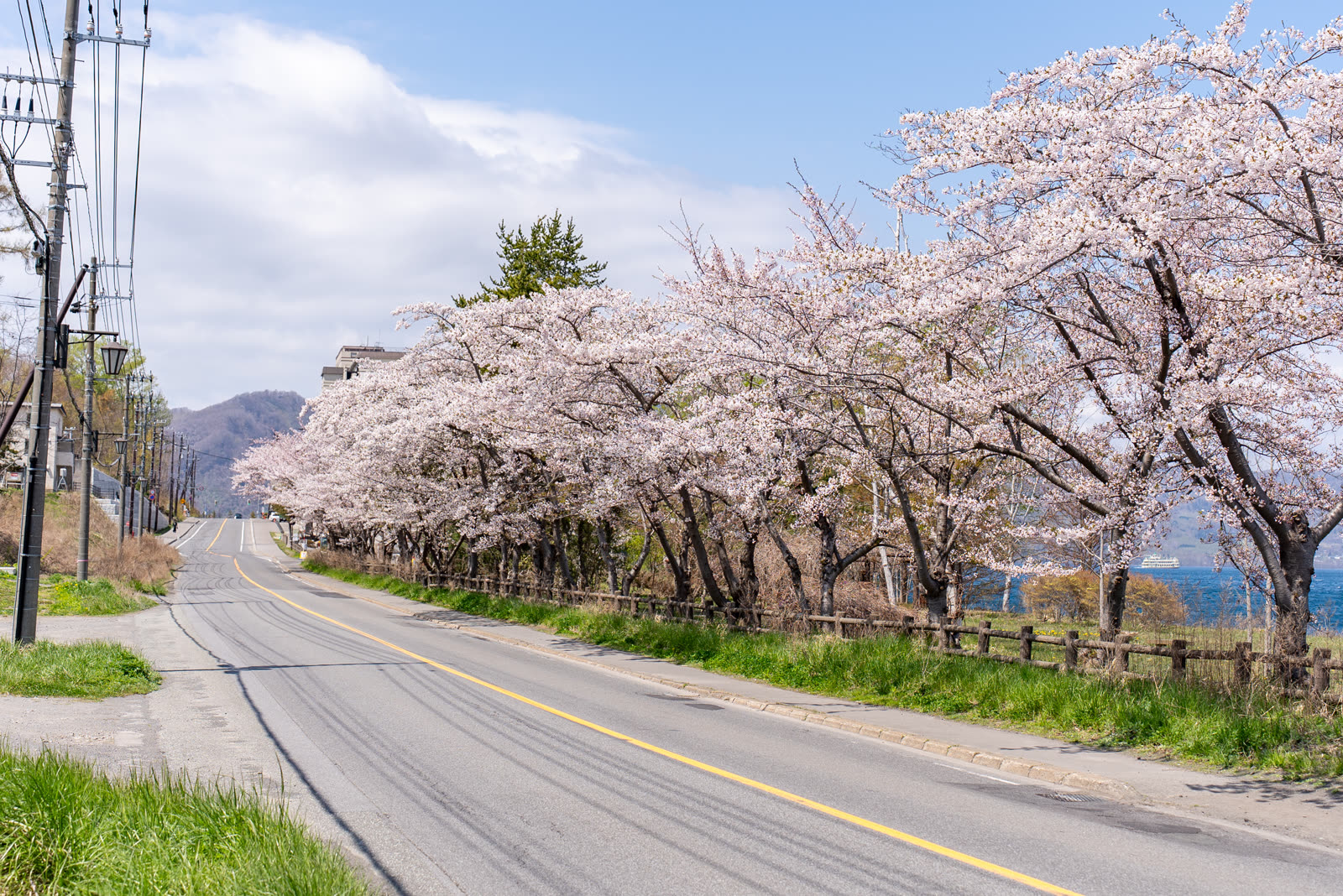
Rather than chasing cherry blossoms alone, weaving in the lake, the volcanoes, and other flowers makes the drive richer.
- Silo Observatory: A panorama overlooking Lake Toya and Nakajima. A great spot to take in the color of the blossoms from above.
- Showa-Shinzan & the Usuzan Ropeway: A geopark-worthy landscape of volcano and lake side by side.
- Lake Hill Farm: Pasture scenery and gelato—just the right place for a break.
- Wakasaimo Honpo: A classic Lake Toya souvenir shop, where many people stop on the way home.
If you’d like to indulge in a few more flowers, you can venture beyond the lake as well. In the neighboring town of Sobetsu, the plum grove at Sobetsu Park has about 300 Bungo plum trees, usually at their best around mid-May. The parking lot at the summit doubles as an observation deck, so without walking you can take in Lake Toya, Nakajima, Mount Yotei, Mount Usu, and Showa-Shinzan all at once. Admission is free—a welcome spot for those arriving by car.
Usu Zenkoji in Date City is an ancient temple carrying more than 1,100 years of history. In its grounds stands the roughly 200-year-old Ezo mountain cherry known as “Ishiwari-zakura” (the rock-splitting cherry), and the adjacent Zenkoji Nature Park is planted with about 1,000 cherry trees. It is about 20 minutes by car from the Abuta-Toyako IC. Also, along the prefectural road in the Tomioka district of Toyako Town, there is Daffodil Hill, with views of Mount Yotei. This is private land that an individual has cultivated over some 20 years. Please be sure to observe these four rules: do not park on the road, do not enter the fields, do not pick the flowers, and take your trash home with you.
The best times of day and what to bring for a pleasant drive
If you’re driving the shore during cherry-blossom season, morning is best. Early in the day there are fewer cars and people, and with no wind the lake surface turns mirror-like, reflecting the blossoms and mountains. Evening is when the low western sun shines through the blossoms and lights them up, giving a different look from the morning. Conversely, from around 11:00 to 14:00 in the middle of the day, sightseeing traffic tends to concentrate, making both parking and photography less relaxed.
Through early April, snow may still remain on the road surface. Even in May the mornings and evenings are chilly, so if you plan to get out and walk, bring an extra layer to throw on. The Lake Toya Marathon is usually held along the shore in May, and in some years it overlaps with cherry-blossom season. On the day, some sections are subject to traffic restrictions, so please check the event information in advance.
For route planning, see the Lake Toya lakeside drive guide, and for a way to combine it with sightseeing, the Lake Toya model sightseeing course. If you’d like to build a one-night, two-day trip around flowers, our spring flower-viewing model course is another option.
Lodgings to use as a base for your cherry-blossom drive
Every Kamonoya lodging is a whole-house or whole-room rental with a full kitchen. Because it’s a private space where you won’t run into other guests, you can set off first thing in the morning and, when you’re tired from driving, rest without having to worry about anyone else.
- A base within walking distance of the lakeside blossoms: Toya House (sleeps 8, from ¥24,000/night). A whole-house rental in the heart of the onsen town, where you can leave the car parked and head out to see the morning blossoms.
- For those who want to enjoy the rural scenery too: Toya Farmer’s House (sleeps 18, from ¥25,000/night). A large whole-house rental set in farming country, with lone cherry trees and field views close at hand.
- For those who want to savor spring in quiet: Cloud9 Toya (sleeps 11, from ¥27,000/night). A hideaway-style whole-house rental away from the bustle.
- For a light-footed trip for two: Lake Toya Building 1R (sleeps 3, from ¥7,000/night). An apartment-type unit in the town center.
You can view our other properties from the list of facilities.
Booking directly through our official site is the best-value official rate, with no agency commission (best-rate guarantee). Check availability here
FAQ
Q. How much time should I set aside for the cherry-blossom drive?
The loop around the lake is about 40 km, roughly an hour by car, but during cherry-blossom season you’ll want to take photos and walk along the shore, so setting aside about half a day lets you make the loop with room to spare. If you extend to the plum grove at Sobetsu Park or Usu Zenkoji, it becomes a full-day itinerary.
Q. When are the cherry blossoms at their best?
The lakeside blossoms are usually at their best in early May, around Golden Week. The timing shifts with the temperature, and the period of full bloom is not long. Late bloomers such as double-flowered cherries can also be seen.
Q. Do the lodgings have parking?
Whether parking is available and how many spaces there are vary by property. If you plan to come by car, please check each property page or inquire in advance.