In Hokkaido, spring arrives about a month later than on the main island of Honshu. What makes the Lake Toya area so interesting is that within this late spring, cherry blossoms, plum, daffodils and azaleas bloom almost back to back. Rather than Honshu’s rhythm of “plum finishes, then some weeks later the cherry blossoms,” here the flowers hand over from one to the next in the space of just a few weeks. Kamonoya, which runs 11 whole-house rentals at Lake Toya, has laid out the best viewing times from April to June in chronological order. For the bigger picture of spring at Lake Toya, see our spring Lake Toya guide, and for the year’s events, our Lake Toya annual event calendar.
The April–June flower calendar at a glance
The rough sequence is as follows. All are typical guidelines, and the timing shifts earlier or later depending on that year’s temperatures.
- Late April: Around when the cherry blossoms at Usu Zenkoji Temple begin to open. The Lake Toya Long-run Fireworks Festival also typically opens around this time.
- Early May (around Golden Week): The cherry blossoms along the shores of Lake Toya reach their peak. The cherry blossoms at Zenkoji Nature Park also come into their prime. From just after the holidays, Daffodil Hill begins to take on color.
- Mid-May: The plum grove at Sobetsu Park is at its best. The azaleas at Usu Zenkoji Temple also begin to bloom. This is the most lavish period, when cherry, plum and daffodils overlap.
- Late May: The daffodils enter their final stretch. The azaleas reach their peak.
- June: At Usu Zenkoji, the “temple of flowers,” the azaleas give way to peonies and then to hydrangeas. The lakeside enters its season of fresh green.
Depending on the year and how much sun a given spot receives, the blooming order can shift around. When planning your trip, please check the latest flowering conditions through the official announcements of each town and tourism association.
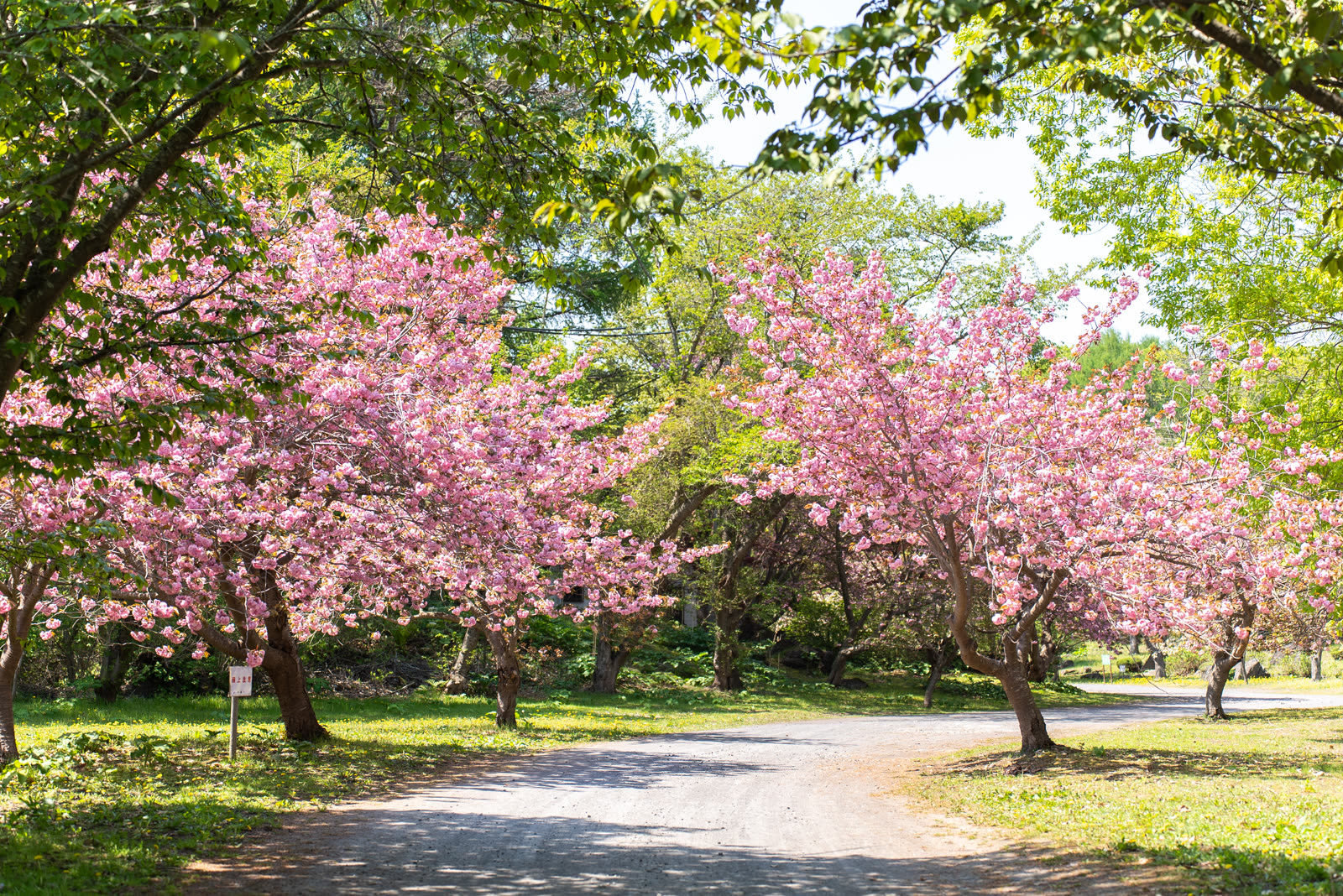
Cherry blossoms — typically late April to mid-May
Cherry blossoms are the first to announce spring around Lake Toya. Because they reach their peak just as the blossoms have finished falling in Honshu, this is also a season for “a second round of hanami.”
The earliest to stir is Usu Zenkoji Temple in Date City. This ancient temple carries over 1,100 years of history, and within its grounds stands the roughly 200-year-old Ezo mountain cherry known as the “Ishiwari-zakura” (Rock-splitting Cherry). Designated a protected commemorative tree of Hokkaido, this lone cherry and the temple grounds are typically at their best from late April to mid-May. The adjacent Zenkoji Nature Park has about 1,000 cherry trees of many varieties—Somei-yoshino, mountain cherry, weeping cherry and Ezo mountain cherry among them—so across the park as a whole the blossoms can be enjoyed over a long stretch, typically from early to late May. For details, see our guide to Usu Zenkoji Temple and the Ishiwari-zakura. It is about a 20-minute drive from the Date IC or Abuta-Toyako IC on the Do-o Expressway.
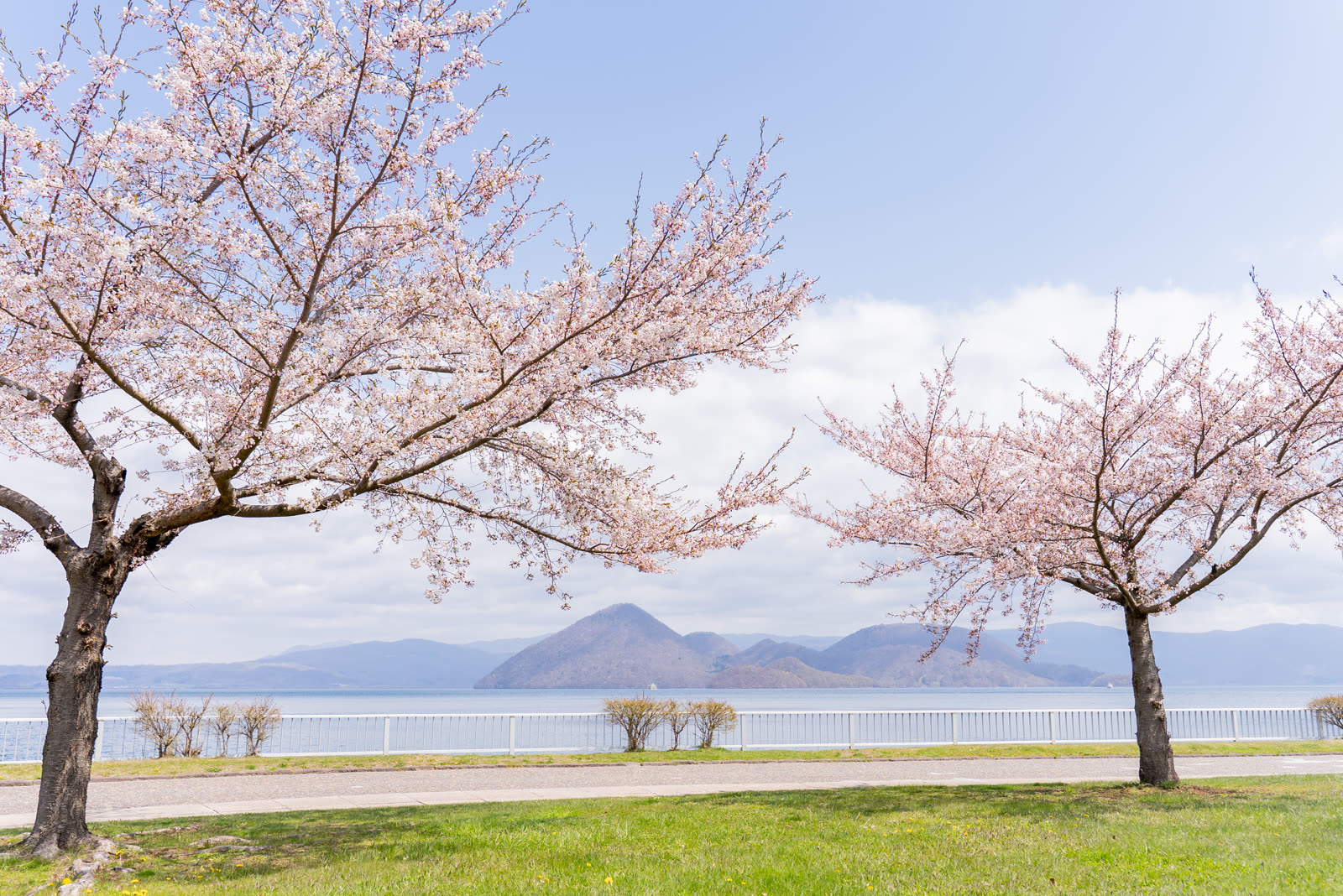
The cherry blossoms along the shores of Lake Toya, on the other hand, are typically at their peak in early May, around Golden Week. There are rows of cherry trees along the lakeside and the town’s roads, with spots where you can gaze out over Lake Toya, Nakajima, Mount Usu and Mount Yotei through the blossoms. At this time of year snow still lingers on the mountains, and it is only for these few days that you can see the pale pink, the white of the remaining snow and the blue of the lake all at once. Late-blooming double cherry blossoms can be seen too. For how to tour them, see our Lake Toya cherry blossom drive, and for a roundup of the best spots, our Lake Toya cherry blossoms and spring highlights.
Plum — typically around mid-May
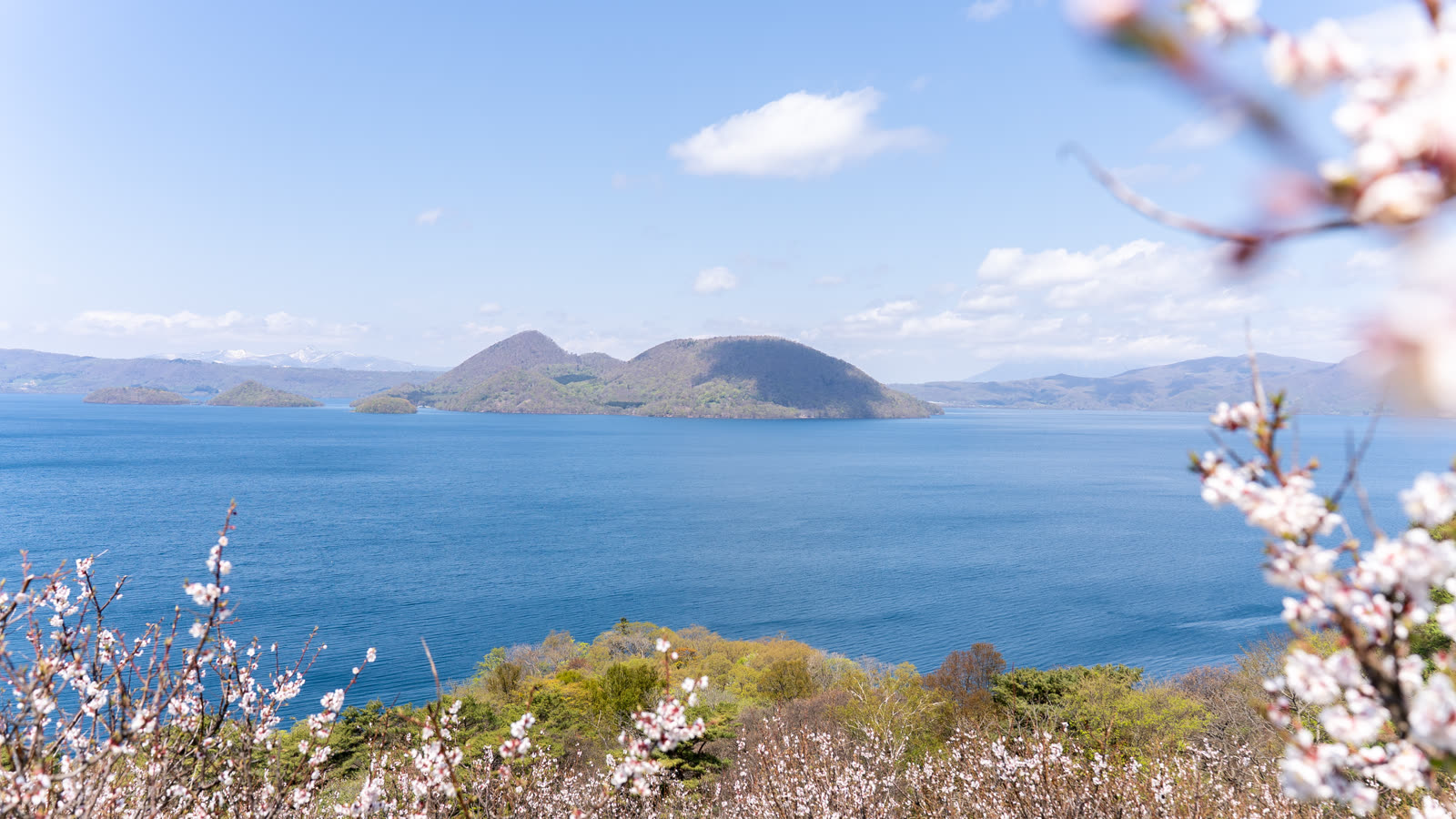
Just as the cherry blossoms begin to fade, the plum comes into full bloom in the neighboring town of Sobetsu. To a Honshu sensibility, plum is a flower that comes “before” the cherry, but here it comes a little after—or in some years overlaps with it—which is very Hokkaido.
Sobetsu Park covers about 86,000 m², of which the plum grove is roughly 20,000 m². About 300 Bungo plum trees bloom here. The peak is typically around mid-May, though in some years visitors start arriving from around Golden Week.
What is most delightful about this place is that the parking lot at the summit doubles as the observation point itself. Without climbing a long slope, you can take in Lake Toya, Nakajima, Mount Yotei, Mount Usu and Showa-Shinzan all at once. The view looking down over the lake and mountains through plum branches is among the finest in the Lake Toya area. Admission is free. It lies in the neighboring town, just a short drive from Lake Toya Onsen. For details, see our guide to the Sobetsu Park plum grove.
Daffodils — typically early May (after the holidays) to late May
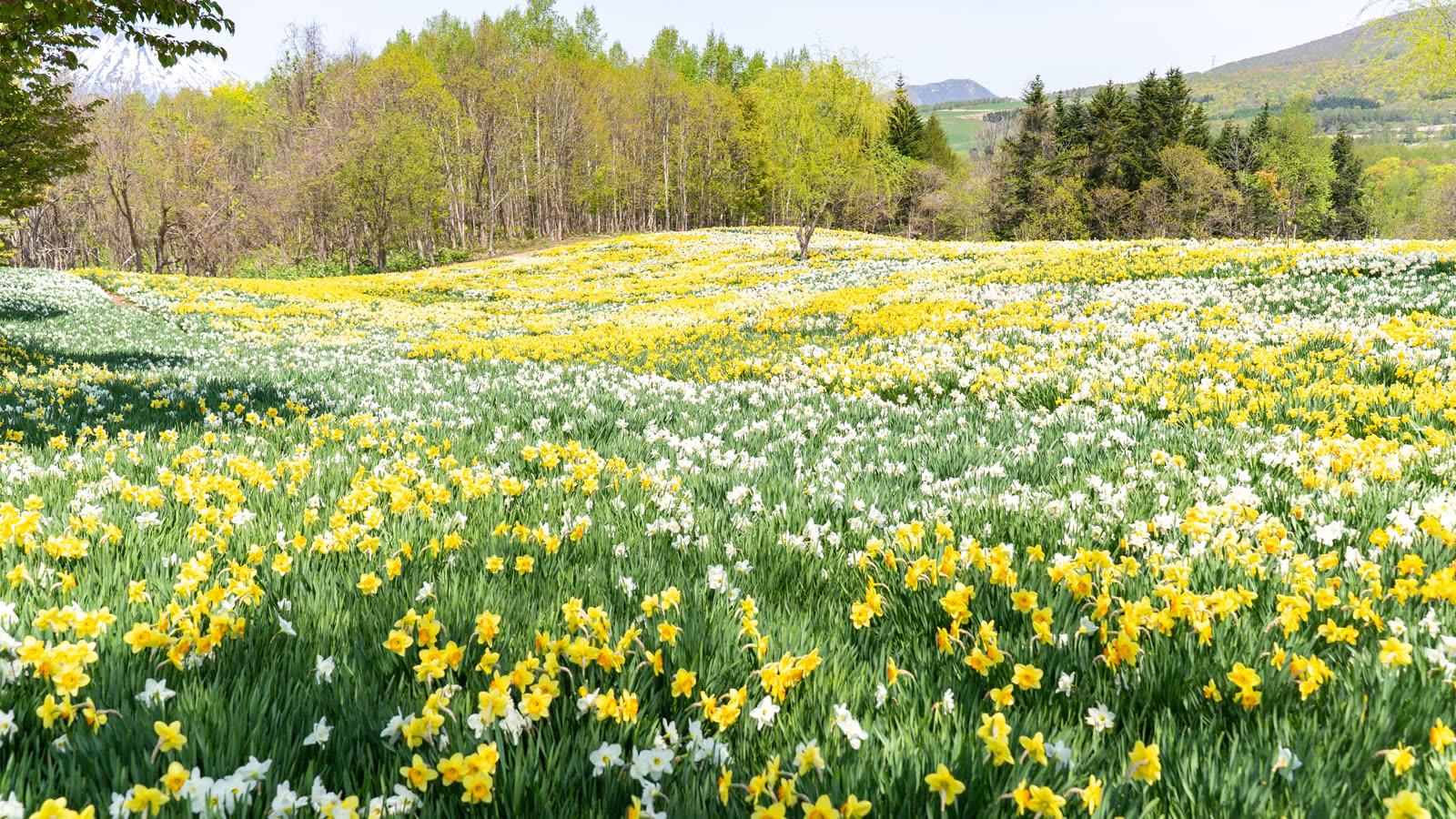
Along a prefectural road in the Tomioka district of Toyako Town lies a slope known as Daffodil Hill. Yellow and white daffodils carpet about 5,000 m², with Mount Yotei rising behind them. The peak is typically from early May, just after the holidays, to late May.
This is not a tourist facility but a place that an individual has spent some 20 years cultivating on their own private land. When you visit, please be sure to observe the following: do not park on the roadside along the prefectural road, do not step into the fields or among the flowers, do not pick the flowers, take your trash home with you, and be considerate of the lives of those living nearby. Whether the site is opened may vary depending on the owner’s wishes and that year’s circumstances. Before visiting, we would be grateful if you would read the etiquette section of our Daffodil Hill guide.
Azaleas — typically mid- to late May
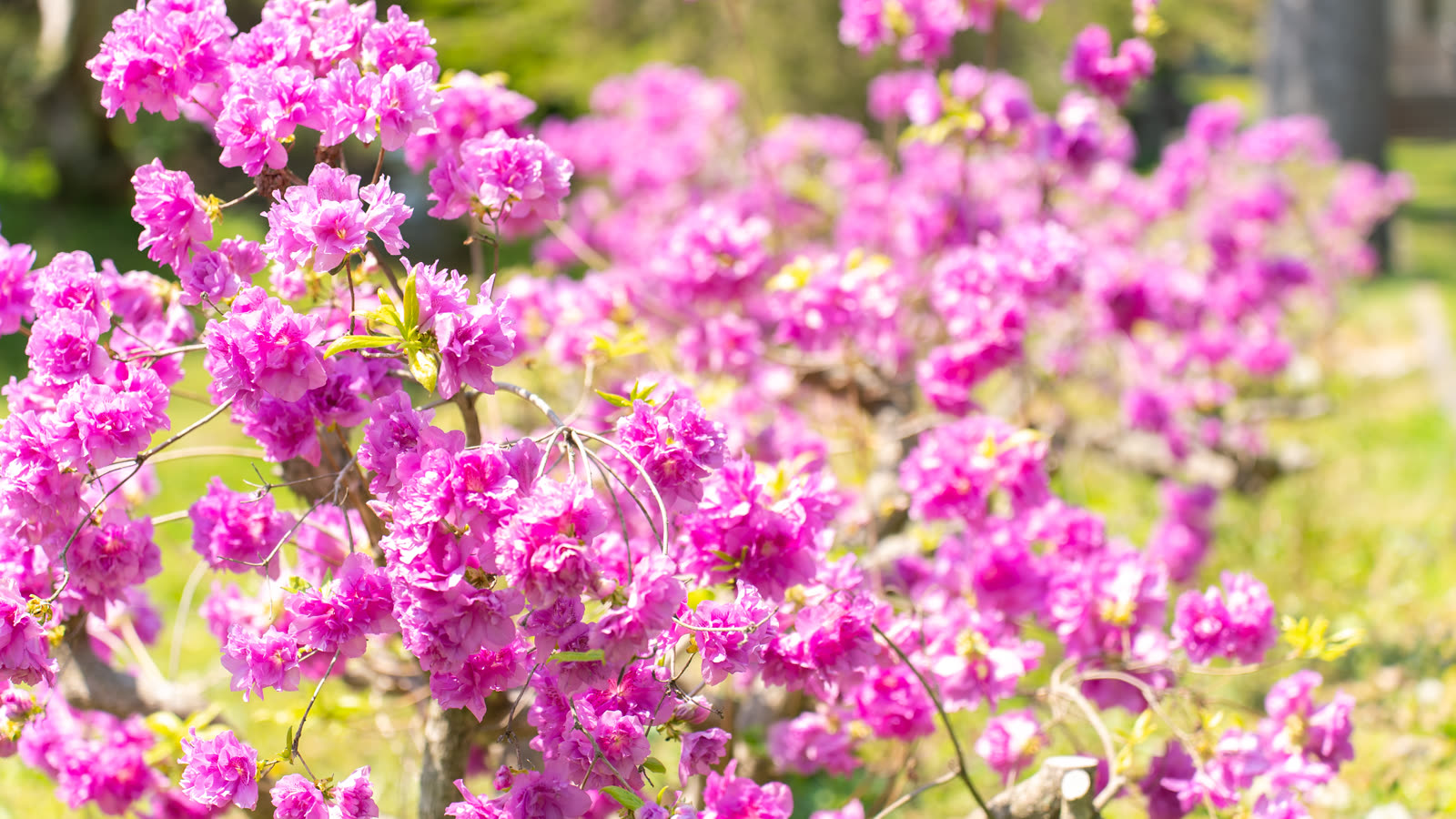
Azaleas bring spring to a close. After the cherry blossoms, the grounds of Usu Zenkoji Temple are painted this time in reds and purples. Because the flowers continue without a break—from cherry to azalea, peony and hydrangea—the temple is known as the “temple of flowers.”
One of the highlights is the calm, thatched-roof main hall. The azaleas seen through the windows of the main hall offer a quiet view, as if the flowers were set within a picture frame—an entirely different face from the exuberance of cherry blossom season. As the grounds are essentially a place of worship, the way to enjoy these flowers is to walk quietly and slowly. For details, see our guide to the azaleas at Usu Zenkoji Temple. For rules and hours regarding visits, please check the official information.
Spring events that overlap with the flowers
The flower season is also the gateway to Lake Toya’s event season. The Lake Toya Long-run Fireworks Festival typically opens in late April, and through the end of October fireworks light up the lake every night for about 20 minutes from around 8:45 p.m. In this season you can have a day of flowers by day and fireworks by night. For details, see our Lake Toya Long-run Fireworks Festival guide.
The Lake Toya Marathon is also typically held around the lake in May. Some sections are subject to traffic restrictions on the day, so if you are planning a flower-viewing drive, please check the Lake Toya Marathon guide together with the event information.
Because the flowers are concentrated into a short period, you can visit several of them even on a one-night, two-day trip. If you would like to build an itinerary by the hour, our one-night, two-day spring flower-viewing model course is handy.
Where to stay during flower season
The peak viewing time shifts within a matter of days. That is exactly why having a base you can set out from first thing in the morning changes the intensity of your trip. Kamonoya’s lodgings are all whole-house or private-unit rentals with fully equipped kitchens. Since you won’t run into other guests, an early start or a late return is no trouble at all.
- For a family flower-viewing trip: Kamonoya Toya House (up to 8 guests, from ¥24,000/night). A whole-house rental in the heart of the onsen town, within walking distance of the lakeside cherry blossoms.
- For a small group, kept casual: Kamonoya Lake Toya Building 2LDK (up to 6 guests, from ¥11,000/night). An apartment-style unit in the town center.
- To savor spring in quiet: Cloud9 Toya (up to 11 guests, from ¥27,000/night). A hideaway-style whole-house rental where you can enjoy fresh greenery and stillness.
You can view all 11 properties on our list of facilities. Reservations tend to concentrate around Golden Week.
Booking directly through our official site is the best-value official rate, with no agency commission (best-rate guarantee). Check availability here
Frequently asked questions
Q. Can I see cherry blossoms, plum, daffodils and azaleas all in one trip?
Around mid-May in a typical year, the chances are high. Around this time, the late-blooming cherry blossoms along Lake Toya, the plum at Sobetsu Park, the daffodils at Daffodil Hill and the azaleas at Usu Zenkoji Temple tend to overlap. That said, the peak shifts earlier or later depending on the year’s temperatures, so if you are aiming to catch several, we recommend deciding your dates after checking the latest flowering information.
Q. Do you need a car to reach all of the spots?
For Sobetsu Park, Daffodil Hill and Usu Zenkoji Temple, traveling by car is the realistic option. The cherry blossoms along Lake Toya include a stretch you can enjoy on foot from the center of the onsen town. Usu Zenkoji Temple is about a 20-minute drive from the Date IC or Abuta-Toyako IC on the Do-o Expressway, or about a 25-minute walk from JR Usu Station. Lake Toya is about 40 km around, roughly an hour by car, so flower-viewing pairs well with a drive.
Q. Can I still enjoy the flowers if I go in June?
Yes. Usu Zenkoji is a “temple of flowers” where the azaleas give way to peonies and then hydrangeas. The timing shifts from year to year. The Lake Toya shore is also beautiful with fresh greenery in June, and the Lake Toya Long-run Fireworks Festival is typically within its run. Crowds ease and lodging becomes easier to book, so for those who want a quiet stay, it is if anything a season we recommend.