In spring, Lake Toya is far too good a place to photograph the flowers alone. Cherry and plum blossoms open in front, the lake spreads out beyond them, and further still stands Mount Yotei, its slopes still capped with snow. Flowers, lake and mountain all in a single frame—that is this region’s finest quality. Kamonoya, which runs 11 whole-house rentals around Lake Toya, shares the way of thinking worth keeping in mind for spring photography, how to read the light that is particular to this place, and the shooting etiquette you must never forget. For the bigger picture of spring at Lake Toya, see our guide to spring at Lake Toya, and for the best cherry-blossom spots, see Cherry Blossoms and Spring Highlights at Lake Toya.

Don’t shoot only the flowers—layer flower, lake and mountain
When a spring photo at Lake Toya turns out “somehow lacking,” the reason is usually that it leans too heavily on the flowers. This is a famous spot for blossoms, but it is equally a land with a powerful backdrop: the lake, the volcanoes and Mount Yotei. Simply keeping three layers in mind—flowers in the foreground, the lake in the middle distance, the mountain in the far distance—makes your photos feel far more like this particular place.
The key to that is to take a few steps before you press the shutter. Shift your standing position slightly left or right, crouch to bring a flower large into the foreground, or move to a higher spot to give more of the frame to the lake. In front of the very same tree, just changing the height and angle of your body changes where the mountain sits in the background. Rather than planting your tripod first, walk around and search for the composition—that is what we recommend.
Know what each spot actually captures
Each of the spring photo locations around Lake Toya frames a different set of elements. Knowing this before you go means you won’t waste your limited time on site.
- Plum grove at Sobetsu Park: A grove of about 300 Bungo plum trees. The parking area at the top doubles as an observation deck, taking in Lake Toya, Nakajima, Mount Yotei, Mount Usu and Showa-Shinzan all at once. Reaching such a sweeping view without a long uphill walk is a real blessing when you’re carrying gear. Free admission. Usually at its best around mid-May. For details, see our guide to the Sobetsu Park plum grove.
- Cherry trees along the Lake Toya shore: Rows of cherry trees line the lakeside and the roads through town, and from some spots you can frame Lake Toya, Nakajima, Mount Usu and Mount Yotei through the blossoms. Late-blooming double-flowered cherries can be seen too. Usually at its best in early May. For how to tour them, see our Lake Toya cherry-blossom drive.
- Daffodil Hill: On a roughly 5,000 m² slope in the Tomioka district of Toyako Town, yellow and white daffodils spread out with Mount Yotei behind them. Usually at its best from just after the early-May holidays through late May. This is private land belonging to an individual. Before you visit, please be sure to read the etiquette in our Daffodil Hill guide.
- Usu Zenko-ji Temple: In its grounds stands “Ishiwari-zakura,” an Ezo mountain cherry roughly 200 years old, and the adjoining Zenko-ji Nature Park holds about 1,000 cherry trees. After the cherries come azaleas—it is truly a “temple of flowers.” For the cherries see Usu Zenko-ji and Ishiwari-zakura, and for the azaleas see the azaleas of Usu Zenko-ji.
For every one of these flowers, peak bloom shifts earlier or later depending on that year’s temperatures. Please check the official announcements of the relevant municipalities and tourist associations for the latest bloom conditions.
Morning and evening: the light decides the shot
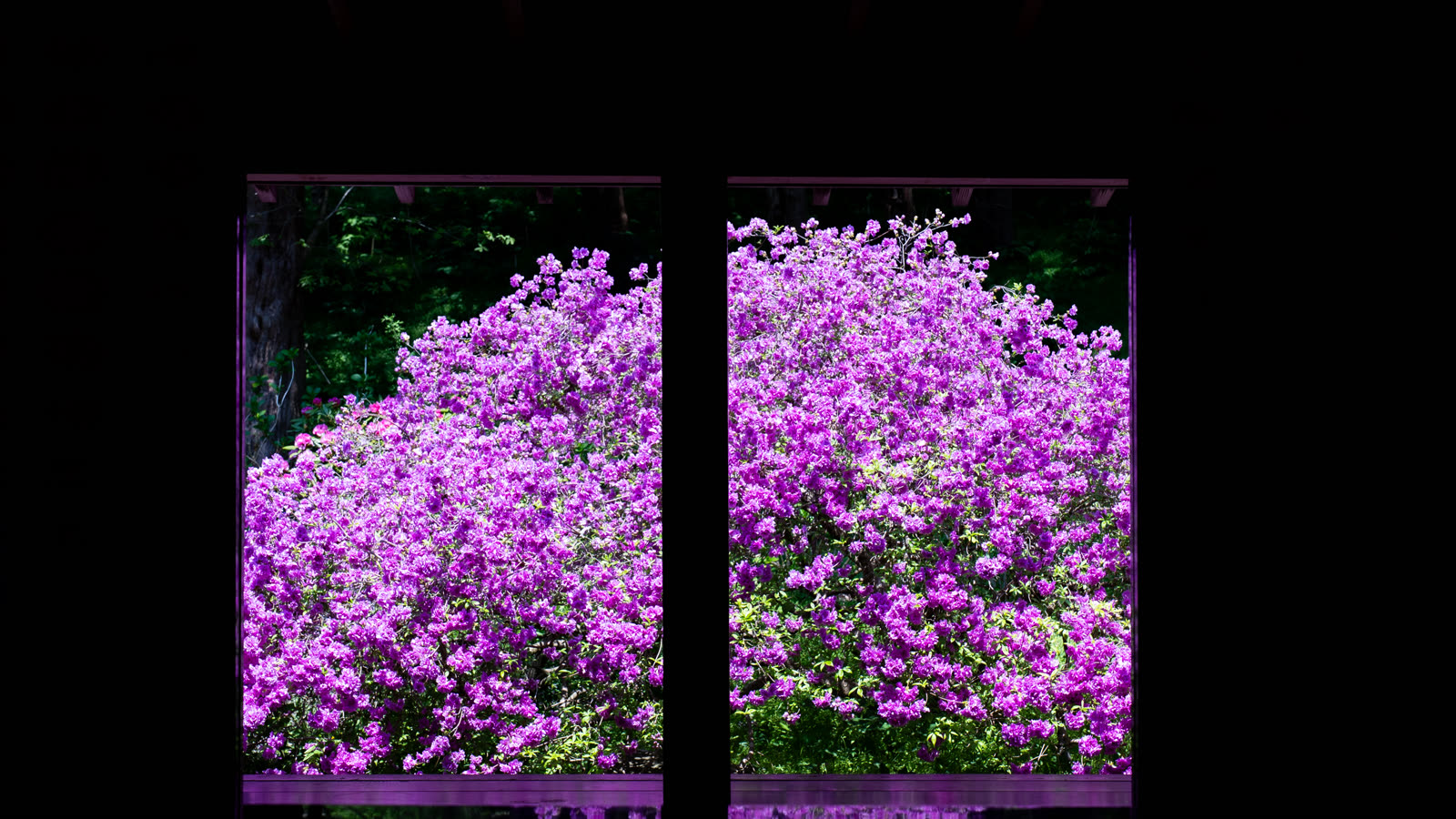
Even in the same place, a photo can become an entirely different thing depending on the time of day. At Lake Toya in spring, the early morning is especially worth aiming for. The air is clear, the lake surface is calm, and the distant ridgeline of Mount Yotei often stands out sharply. As the sun climbs, the far distance can turn hazy, so if you want the mountain large in the frame, giving priority to the morning will lead to fewer misses.
In the evening, low, raking light shines through the petals and gives the colours depth. If you want the flowers to be the star, this is the time. The high light of midday, by contrast, casts hard shadows and easily blows out the whites and soft pinks of the flowers, which makes a lightly overcast day rather convenient: the colours come out naturally and the gradations of the cherries and daffodils are preserved. Instead of assuming “I can only shoot on a clear day,” decide to take close-ups of the flowers on cloudy days and wide scenes with the mountain on clear mornings, and planning your day becomes much easier.
One more thing: spring mornings and evenings are quite cold. Heading out with a pair of gloves makes morning shooting far more comfortable.
Wide and telephoto: two ways of seeing

The gear and settings you use change with the day’s light and your standing position. Rather than numbers, think of it here as two ways of seeing.
The wide-angle view “tells a relationship.” Move in close to the flowers in the foreground and gather the lake and mountain behind them. The spatial relationship of flower, lake and mountain comes across just as it is, and a single frame conveys “what kind of place this is.” The closer you move in, though, the smaller the background mountain becomes, so how much of the sky you include and how large you make the foreground flowers greatly changes the impression.
The telephoto view “crops and layers.” You can pull distant Mount Yotei in large and bring the foreground flowers and the mountain close together. Another advantage is that it lets you push distracting background elements out of the frame. It comes into its own in places like the observation deck at Sobetsu Park, where a distant range of mountains can be seen all at once.
The thinking is the same with a smartphone. By switching between ultra-wide and telephoto, or by moving closer or further away yourself, you can try these same two ways of seeing. Neither is the “correct” one; shoot the same subject both ways and you’ll be able to choose once you’re home.
Shooting etiquette—what to respect on private land and temple grounds

The spring photo spots around Lake Toya include places that are not tourist facilities. Get this wrong, and next year that scenery may no longer be there to see.
Daffodil Hill is a place that an individual has spent some 20 years cultivating on their own private land. Don’t park on the roadside along the prefectural road, don’t step into the fields or among the flowers, don’t pick the flowers, always carry your rubbish home, and be considerate of the lives of the nearby residents. These are the bare minimum of manners for a photographer. Whether the hill is opened at all may vary with the owner’s wishes and the conditions of the year. Please visit thinking of it as “a place we are allowed to photograph.”
Usu Zenko-ji is an ancient temple carrying more than 1,100 years of history, known as one of the three official temples of Ezo. Its grounds are, first and foremost, a place for worship. Pay your respects first and only then raise your camera; don’t set up a tripod where it blocks a path; don’t call out loudly to one another while shooting; and take care not to interfere with services or worshippers. The azaleas seen through the windows of the thatched main hall are a striking sight, but please check the official guidance for whether photography inside the hall is permitted and for the rules on visiting.
Across all of these places: don’t tread into flower beds or the roots of trees, don’t pull branches toward you, and don’t park on farmland or work roads. This is a request from those of us who live here.
Lodgings that make an easy base for a photography trip
If you’re aiming for the morning and evening light, the location and comfort of your lodging translate directly into how much good work you come home with. Every Kamonoya property is a whole-house or whole-room rental with a full kitchen. Since you never cross paths with other guests, you can head out while it’s still dark or spread out wet gear to dry without any awkwardness. You can build a luxurious rhythm: shoot at the lakeside at first light, then return for a leisurely breakfast at your lodging.
- For walking and shooting the lakeside morning: Toya House (sleeps 8, from ¥24,000/night). A whole-house rental in the heart of the onsen town, within walking distance of the lakeside.
- For a light-footed solo or two-person trip: Lake Toya Building 1R (sleeps 3, from ¥7,000/night). An apartment-type unit in the town centre.
- For small groups who want room to spread out gear: Toya Terraced House (sleeps 4, from ¥11,000/night). A calm, whole-room rental in the town centre.
- For a group of fellow photographers: Lake Toya Base (sleeps 20, from ¥30,000/night). A shared base for a large party.
To tour the photo spots by circling the lake is about 40 km, roughly an hour by car. Our lakeside drive guide and model itinerary are also helpful for planning your route. You can view all 11 properties from our list of facilities.
Booking directly through our official site is the best-value official rate, with no agency commission (best-rate guarantee). Check availability here
FAQ
Q. When can I photograph both the flowers and snow-capped Mount Yotei together?
Early to mid-May is the sweet spot in most years. The cherries along the Lake Toya shore are usually at their best in early May, the plums at Sobetsu Park around mid-May, and Daffodil Hill from just after the early-May holidays through late May—a season when snow still often lingers on the mountain. Bloom and remaining snow both shift earlier or later with that year’s temperatures, however, so please check the latest information before you set out.
Q. Can I photograph Daffodil Hill freely?
Because it is a place an individual has cultivated on private land, it is not a “tourist facility where you may shoot freely.” Don’t park on the roadside or step into the fields, don’t pick the flowers, carry your rubbish home, and be considerate of the neighbours’ lives. Whether it is opened may vary with the owner’s wishes and the conditions of the year. For details, see our Daffodil Hill guide.
Q. Can I use a tripod or a drone?
Please use a tripod only where it does not block paths or worshippers’ routes and does not get in others’ way. On temple grounds and private land, the rules of that place take priority. As for drones, each location has its own manager’s permission requirements and legal restrictions, so please avoid flying without permission on private land, temple and shrine grounds, or in parks, and check with the manager in advance.